
Companies are investing heavily in AI, Microsoft Fabric, Databricks, cloud analytics, and increasingly sophisticated business intelligence tools to uncover more value from their data.
But there is a fundamental infrastructure challenge: the data these platforms need often lives somewhere else.
Customer transaction data may sit in Oracle. Supply chain records may live in Db2. Orders may run through SQL Server. Financial systems, ERP applications, and operational databases were built to run the business, not necessarily to continuously power analytics and AI.
That creates an increasingly important question:
How does the right data get from the systems where business happens into the systems where AI and analytics happen?
Many organizations still rely on batch processes that move data every few hours or overnight. That may work for historical reporting, but it becomes more limiting when AI and analytics are expected to reflect what is happening now.
As companies rely on data to make faster decisions, the delay between an event and that information becoming available downstream matters more.
Moving From Batch Data to Continuous Data
The answer is not necessarily moving more data. It is moving the right data more efficiently.
Change data capture (CDC) identifies changes as they happen within operational systems and continuously replicates them to the platforms that need them. Instead of repeatedly moving entire datasets on a schedule, only new or changed information is sent downstream.
This creates a more direct connection between operational systems and platforms such as Microsoft Fabric, Databricks, Snowflake, and BigQuery.
For AI and analytics teams, the benefit is straightforward: fresher dashboards, more current analytics, and AI systems working from data that better reflects what is happening across the business.
But keeping data current is only part of the challenge. Organizations also need flexibility in where that data can go next.
Keeping the Architecture Open
As data environments become more complex, building data movement around a single destination can make future changes more difficult.
Stelo is designed to keep that architecture open.
Rather than tying replication to one analytics platform or cloud ecosystem, Stelo allows organizations to continuously move operational data across the platforms they choose.
That gives businesses a more flexible foundation for analytics and AI as their technology stack evolves.
A Data Replication Layer Built for What Comes Next
The replication layer connecting operational systems to analytics and AI needs to keep data current, support different platforms, and do so without creating another infrastructure burden.
Stelo is designed around that idea: moving data from the systems where the business operates to the platforms where that data creates value.
Open. Move data across sources and destinations without building around a single cloud or analytics platform.
Fast. Continuously replicate changes so analytics and AI platforms have access to current operational data.
Lightweight. Reduce the infrastructure and engineering effort required to build and maintain data pipelines.
Once organizations decide they need continuous replication, another practical tradeoff emerges: how broadly can a platform reach across operational data sources, and how much effort does it take to deploy and operate?
The matrix below compares the data replication landscape across those two dimensions: supported operational sources and operational lift.
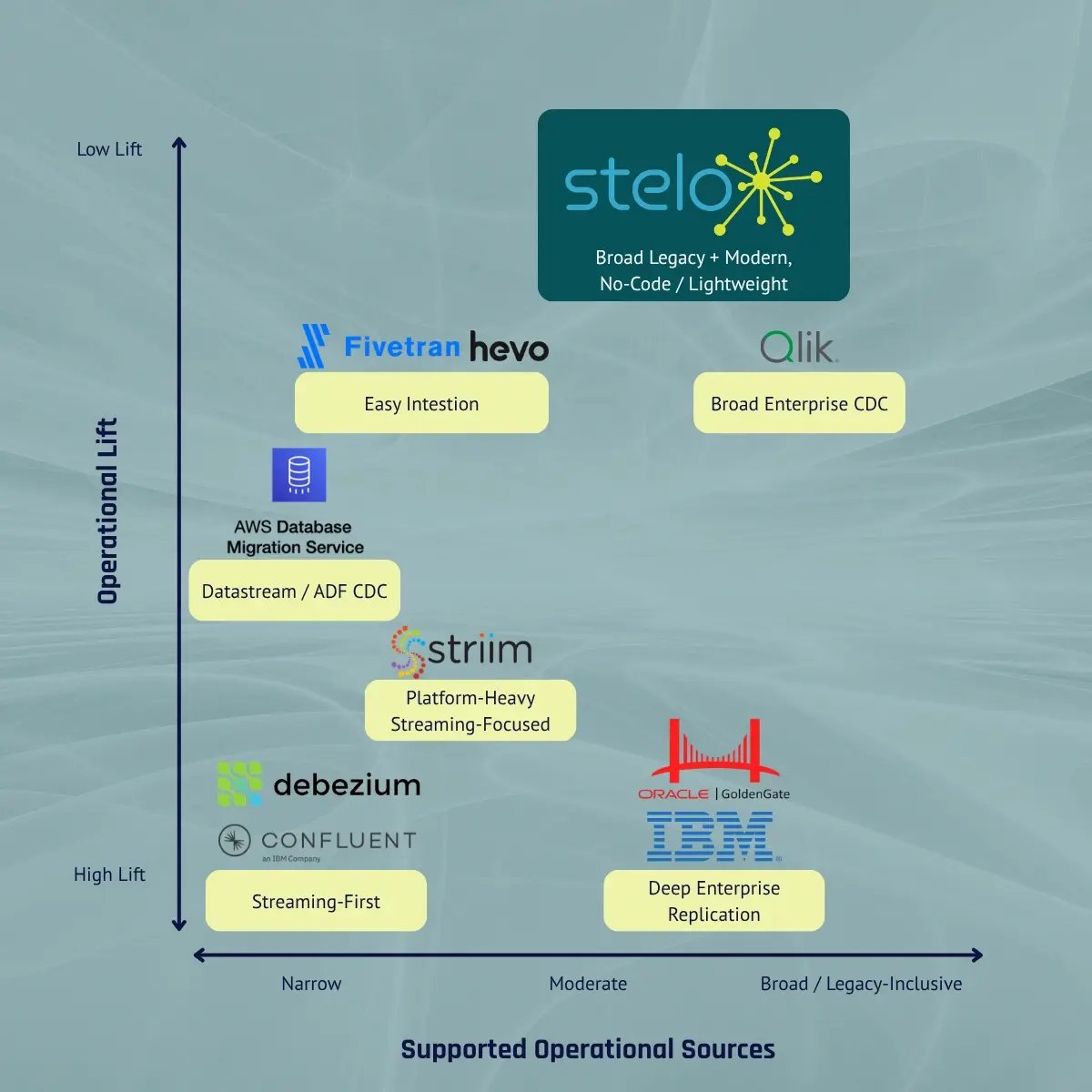
For organizations building for AI, the goal is not simply to move data continuously. It is to reach the operational data the business depends on while keeping the replication layer manageable as the environment grows.
As AI strategies evolve, the infrastructure connecting those systems will matter just as much as the intelligence built on top of them.
Learn more about Stelo’s supported technologies by downloading our Technical Data Sheet for a detailed product overview in the comments below.